Affiliate Disclosure: This article contains affiliate links. If you purchase through our links, we may earn a commission at no extra cost to you. Our reviews are independent and honest.
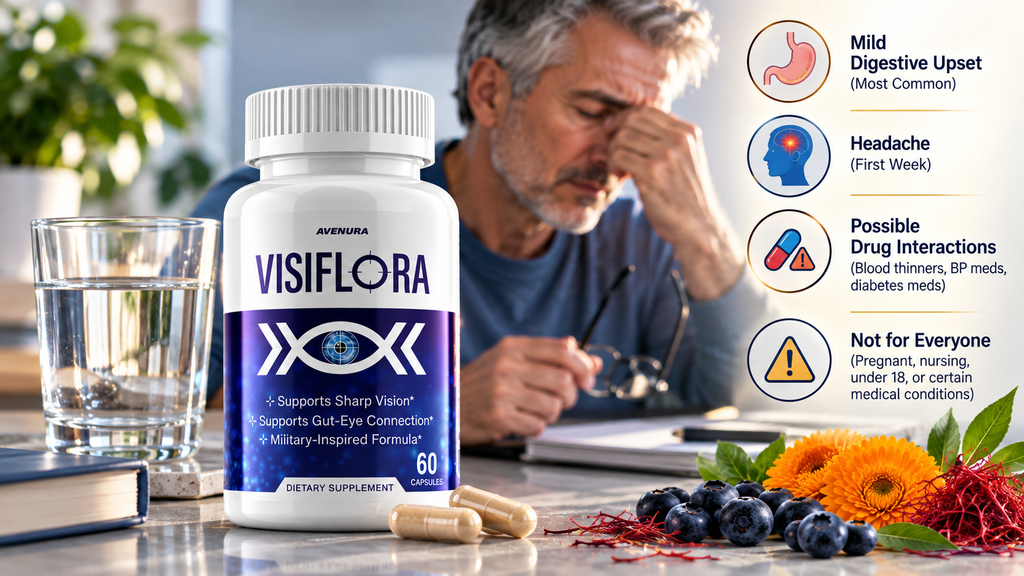
VisiFlora is a 22-ingredient eye supplement marketed around the gut-eye connection. For most healthy adults, it is well tolerated. The most common complaints are mild digestive discomfort in the first week, usually when taken on an empty stomach. Those side effects typically pass within a few days.
That said, a handful of specific ingredients in this formula carry real interaction risks — particularly for people on blood thinners, blood pressure meds, or blood sugar medications. And because most of the formula sits inside a 351 mg proprietary blend with no individual doses disclosed, it is harder than usual to assess exactly how much risk you are taking.
This article covers everything: which ingredients cause what, who is genuinely at risk, what real users say, and what questions to ask your doctor before you start.
Quick Verdict on VisiFlora Side Effects
| Category | Details |
|---|---|
| Product Name | VisiFlora |
| Manufacturer | PhytoThrive Labs |
| Price | $49–$79 per bottle (official site) |
| Refund Policy | 60-day money-back guarantee |
| Format | Once-daily vegetable capsule |
| Common Side Effects | Mild digestive upset, bloating, headache (first week) |
| Serious Risks? | Low for most; higher if on blood thinners, BP meds, or diabetes meds |
| Safe for Smokers? | Beta carotene warrants caution — discuss with doctor |
| Safe in Pregnancy? | Not recommended without physician approval |
| Drug Interactions | Yes — ginkgo biloba, coleus forskohlii, chromium, alpha lipoic acid |
| Recommended For | Healthy adults 35+ with screen fatigue, mild age-related vision changes |
| Not For | Under 18, pregnant/nursing, blood thinner users (without doctor clearance) |
What Is VisiFlora?
VisiFlora is a once-daily vision support supplement made by PhytoThrive Labs. It is sold exclusively through the official website and backed by a 60-day refund policy. The formula contains 22 ingredients spread across four functional groups:
- Vision Defense Matrix — Astaxanthin, Vitamin C, Vitamin E, Copper, Selenium, Chromium
- Gut-Eye Barrier Complex — Grape Seed Extract, Rutin, Quercetin, Taurine, Alpha Lipoic Acid
- Vision Performance Boosters — Ginkgo Biloba, Coleus Forskohlii, Eyebright
- Macular & Lens Support Blend — Vitamin A (Beta Carotene), Lutein, Zeaxanthin, Zinc, Bilberry, Lycopene, Saffron
Seven ingredients (Vitamin A, C, E, Zinc, Copper, Selenium, Chromium) are disclosed at specific doses. The remaining 14 sit inside a 351 mg proprietary blend with no individual amounts shown. That detail matters a lot when you are trying to assess side effect risk — more on that below.
VisiFlora is non-GMO, vegan, stimulant-free, and manufactured in an FDA-registered, GMP-certified facility. Purchases are processed through BuyGoods, not a subscription — one-time purchase only.
VisiFlora Side Effects: The Full List
Based on the formula’s ingredient profile and user feedback gathered from forums, Reddit, Quora, and independent review platforms, here is what can realistically happen when you start VisiFlora:
Common (Low Severity — Usually Temporary)
- Digestive upset / bloating — The most frequently reported issue, mostly in the first 3–7 days. Almost always linked to taking the capsule on an empty stomach. Taking it with food usually solves this.
- Mild nausea — Can occur in the first week, again most common without food. Zinc at higher doses is a nausea trigger, though VisiFlora’s 11 mg zinc dose is relatively modest and within safe daily intake levels.
- Loose stools or changes in bowel movements — Some users report this in the first week as the body adjusts to new botanical ingredients.
- Headache or mild dizziness — Noted by a small number of users, could be related to ginkgo biloba or coleus forskohlii affecting blood pressure or circulation.
- Stool or urine color changes — High carotenoid intake (lutein, zeaxanthin, lycopene, beta carotene) can sometimes slightly alter stool color. Completely harmless, but can be surprising if you are not expecting it.
Uncommon (Moderate Concern)
- Skin yellowing (Carotenodermia) — Very high carotenoid intake over time can cause a harmless yellowing of the skin, particularly on palms or soles. It reverses when intake is reduced. It is not jaundice. At VisiFlora’s dose levels this is unlikely, but possible if you also eat a carotenoid-heavy diet.
- Allergic reactions — Skin rash, itching, or hives can occur in people sensitive to any botanical ingredient in the formula (bilberry, eyebright, grape seed, saffron, quercetin, etc.). If you develop hives or breathing changes, stop immediately and seek medical attention.
- Eye irritation — A small number of users on negative review sites report this. It is not a direct effect of any ingredient on the eye (this is an oral supplement), but it could indicate an allergic response or ingredient sensitivity.
Rare (High Severity — Seek Medical Attention)
- Bleeding complications — Ginkgo biloba and bilberry both have mild antiplatelet effects. If you are on blood thinners (warfarin, aspirin, clopidogrel), this combination could increase bleeding risk. Do not self-experiment.
- Blood pressure fluctuation — Coleus forskohlii can lower blood pressure. Combined with antihypertensive medications, this could cause blood pressure to drop too low.
- Blood sugar drops — Alpha lipoic acid and chromium both affect insulin sensitivity. If you take diabetes medications, this could lead to hypoglycemia.
- Seizure risk increase — Ginkgo biloba can lower the seizure threshold in rare cases. Anyone with a history of seizures should consult a neurologist before starting.
Important: If you experience sudden floaters, flashes of light, a curtain or shadow across your vision, sudden vision loss, or acute eye pain — these are NOT supplement side effects. They are warning signs of a serious eye condition. Stop any supplement and see an eye doctor or emergency room immediately.
Ingredient-by-Ingredient Risk Breakdown
Here is an honest look at the specific ingredients in VisiFlora that carry the most meaningful safety context:
| Ingredient | Potential Risk | Who Needs to Be Careful |
|---|---|---|
| Ginkgo Biloba | Antiplatelet effect, can lower seizure threshold, blood pressure interaction | Anyone on blood thinners, seizure history, upcoming surgery |
| Beta Carotene (Vitamin A) | At high supplemental doses, increased lung cancer risk in current/former smokers (noted in CARET & ATBC trials) | Current smokers, former smokers, asbestos-exposed individuals |
| Coleus Forskohlii | Lowers blood pressure; may interact with antihypertensive drugs | Those on blood pressure medications |
| Alpha Lipoic Acid | Enhances insulin sensitivity; may lower blood sugar | Diabetics on insulin or oral hypoglycemics |
| Chromium | Affects glucose metabolism; interaction with insulin and metformin | Diabetics and those on blood sugar medications |
| Bilberry Extract | Mild antiplatelet effect, may potentiate blood thinners | Anyone on anticoagulants or aspirin therapy |
| Quercetin | Can interact with antibiotics and immunosuppressants at high doses | Organ transplant recipients, those on specific antibiotics |
| Zinc (11 mg) | Nausea at higher doses; VisiFlora’s dose is modest and within safe levels | Low risk at disclosed dose; avoid stacking with other zinc supplements |
| Astaxanthin | May affect blood pressure and blood thinners at high doses | Generally well-tolerated; precaution if on BP meds |
| Lutein, Zeaxanthin, Lycopene | Very safe at supplement doses; possible carotenodermia with excess | Generally safe for most adults |
Who Should NOT Take VisiFlora
Be direct about this section — it matters:
- ❌ Children under 18 — Not formulated or tested for pediatric use
- ❌ Pregnant or breastfeeding women — Multiple botanicals with unknown effects in pregnancy; consult your OB first
- ❌ Current smokers or recent ex-smokers — Beta carotene supplementation has shown increased lung cancer risk in this group in large clinical trials (CARET and ATBC studies). This is a real, documented risk — not a minor caution.
- ❌ People on blood thinners (warfarin, aspirin, clopidogrel) — Ginkgo and bilberry can amplify anticoagulant effects
- ❌ People on blood pressure medications — Coleus forskohlii can enhance the blood pressure lowering effect
- ❌ People on diabetes medications — Alpha lipoic acid and chromium can lower blood glucose further
- ❌ Seizure history — Ginkgo biloba can lower seizure threshold
- ❌ Pre-surgery patients — Ginkgo and bilberry increase bleeding risk; most surgeons advise stopping herbal supplements 2 weeks before any procedure
- ❌ Known allergies to botanicals — Especially carotenoid-rich plants, members of the daisy/asteraceae family (eyebright belongs here), or grapes (grape seed extract)
Drug Interactions to Know
This is the section most affiliate reviews skip entirely. Here are the interaction categories you need to bring up with your doctor or pharmacist:
- Anticoagulants & antiplatelets — Warfarin, aspirin, clopidogrel, heparin: ginkgo biloba and bilberry may amplify bleeding risk
- Antihypertensives — Lisinopril, amlodipine, losartan, etc.: coleus forskohlii and ginkgo biloba may produce additive blood pressure lowering
- Insulin & oral hypoglycemics — Metformin, glipizide, insulin injections: alpha lipoic acid and chromium can lower blood glucose, increasing hypoglycemia risk
- Seizure medications — Phenytoin, valproate, carbamazepine: ginkgo biloba may reduce medication effectiveness and lower seizure threshold
- Immunosuppressants — Cyclosporine, tacrolimus: quercetin can interfere with drug metabolism
- Some antibiotics (quinolones like ciprofloxacin): quercetin may interact at high doses
- Other zinc supplements — Stacking zinc sources increases nausea and GI distress risk
The honest bottom line: if you take any prescription medication, show your pharmacist the VisiFlora ingredient list before starting. This takes 5 minutes and removes most of the uncertainty.
What Real Users Report
Pulling from third-party forums, Reddit threads, Quora posts, and consumer feedback platforms — here is what the pattern looks like across actual users, not just the testimonials on the sales page:
The majority of positive feedback centers on:
- Reduced eye fatigue and strain, particularly for people working long hours at screens
- Improvement in contrast sensitivity and night vision (most users say this takes 5–8 weeks, not days)
- Better sleep quality, which they attribute to reduced eye strain
- No major side effects — most say the experience was unremarkable, in a good way
Negative feedback tends to come from:
- People who quit in the first two weeks before results could reasonably appear
- Users who took it on an empty stomach and blamed the supplement when the solution was just eating first
- A smaller subset who experienced no benefit at all — which is a real and valid outcome; supplements do not work for everyone
- One pattern that appeared in multiple Reddit complaints: frustration when customer support was slow to respond about refunds. The 60-day guarantee is legitimate, but support response times can apparently be slow.
One Reddit user with 5 weeks of use reported mild bloating and no improvement in eye strain. Another from California described meaningful improvement in screen fatigue after 7 weeks of consistent use. That is a realistic spread — results vary, and no supplement works identically across all users.
The Side Effect Risk No One Else Is Talking About: The Proprietary Blend Problem
Most VisiFlora reviews skip this entirely, and it is the most important thing to understand about the supplement’s safety profile.
Seven ingredients have disclosed doses. Fourteen do not.
All 14 of those undisclosed ingredients are packed into a 351 mg proprietary blend. That includes ginkgo biloba, bilberry, coleus forskohlii, alpha lipoic acid, quercetin, and saffron — all of which carry meaningful safety context depending on dose.
Here is why this matters specifically for side effect assessment:
- Ginkgo biloba is considered relatively safe at 40–120 mg per day in research contexts. At sub-clinical doses it may have no meaningful effect — good or bad. But without knowing the dose, you cannot assess the bleeding risk with any precision.
- Alpha lipoic acid at doses above 300–600 mg can cause nausea, headache, and low blood sugar in susceptible individuals. At trace doses it may not do much at all. The blend is 351 mg total across 14 ingredients — so each ingredient averages roughly 25 mg. That’s likely too low to cause issues, but you genuinely cannot know.
- Beta carotene (outside the blend, disclosed) has a specific documented risk for current and former smokers at supplemental doses. This is not general caution — it comes from the CARET and ATBC clinical trials that were halted early because of increased lung cancer risk in beta carotene supplement users who smoked or had asbestos exposure. If you are or were a regular smoker, this ingredient warrants a real conversation with your doctor, not a shrug.
To be fair: a 351 mg blend spread across 14 ingredients means each is present at a fairly small dose. Many supplements work safely at low doses. The concern is transparency, not necessarily immediate danger. But it makes a definitive safety clearance harder to give, and it is something you should know going in.
VisiFlora Safety vs. Competitor Eye Supplements
| Factor | VisiFlora | PreserVision AREDS2 | EyePromise Restore |
|---|---|---|---|
| Ingredients disclosed with doses? | Partial (7 of 22) | Yes — fully disclosed | Yes — fully disclosed |
| Proprietary blend? | Yes (351 mg, 14 ingredients) | No | No |
| Ginkgo biloba included? | Yes | No | No |
| Beta carotene included? | Yes | No (removed from AREDS2 due to smoker risk) | No |
| Blood thinner interaction risk? | Yes (ginkgo, bilberry) | Low | Low |
| Blood sugar interaction risk? | Yes (ALA, chromium) | None | Low |
| Safe for smokers? | Caution — beta carotene | Yes — specifically reformulated for smokers | Yes |
| 60-day refund? | Yes | Store-dependent | 30 days |
| Number of ingredients | 22 | 6 | 8 |
| Gut-eye positioning | Yes (unique angle) | No | No |
The key difference: PreserVision AREDS2 was specifically reformulated to remove beta carotene after the clinical trial data on smokers came in. VisiFlora still includes it. That is not a deal-breaker for non-smokers, but it is meaningful context.
If you want to look at the full VisiFlora review with ingredient-by-ingredient benefits analysis, see our complete VisiFlora 2026 review — it goes deeper on what each ingredient is supposed to do and whether the evidence holds up.
How to Minimize VisiFlora Side Effects
If you are going to try VisiFlora, these practical steps can meaningfully reduce the chance of experiencing issues:
- Always take it with food. Almost every digestive complaint disappears when users do this. The capsule is easier on the stomach when there is food in it to buffer the botanicals.
- Do not double up on similar supplements. If you are already taking a zinc supplement, extra vitamin E, or another carotenoid product, adding VisiFlora on top risks excess of fat-soluble nutrients. Check what you are already taking.
- Tell your pharmacist or doctor. Especially if you are on any medication — blood pressure, diabetes, blood thinners, seizure meds, or immunosuppressants. Show them the ingredient list, not just the product name.
- Smokers: talk to your doctor specifically about beta carotene. This is the one ingredient in VisiFlora with documented risk data for smokers from large clinical trials. Your doctor may tell you it is fine at this dose — but get that conversation.
- Start and give it time. Most first-week symptoms — bloating, loose stools, mild headache — resolve as your body adjusts. If symptoms are still present after 2 weeks, that is when you reconsider.
- Stop 2 weeks before any planned surgery. This is standard guidance for any multi-ingredient botanical supplement to reduce bleeding risk.
- If you notice any sudden eye symptom changes (floaters, flashes, vision loss, shadows) — these are medical emergencies. Stop everything and see a doctor immediately. These are not supplement reactions.
For more on the ingredient list and what each one does, check our dedicated VisiFlora ingredients breakdown.
👉 If you have checked the above and VisiFlora looks right for you, the safest place to purchase is the official site — it comes with a 60-day money-back guarantee, so you can try it risk-free. There are no subscriptions or recurring charges.
☞ Try VisiFlora Risk-Free for 60 Days — Official Site Only
Pricing & Where to Buy
| Package | Bottles | Price Per Bottle | Total | Shipping |
|---|---|---|---|---|
| Starter | 2 | $79 | $158 | Small shipping fee |
| Advanced | 3 | $59 | $177 | Free US shipping |
| Ultimate | 6 | $49 | $294 | Free US shipping |
All packages include 3 bonus digital ebooks: The Military Vision Protection Manual, The Gut-Eye Healing Protocol, and The 48-Hour Vision Jump-Start.
VisiFlora is only sold on the official website — not Amazon, Walmart, or any other third-party platform. Anything claiming to be VisiFlora on a third-party site is either unauthorized or counterfeit. Your payment processes through BuyGoods and will appear on your statement as “BuyGoods” (not VisiFlora).
There are no recurring charges or subscription enrollment. It is a one-time purchase.
👉 ☞ Check Current VisiFlora Pricing — 60-Day Guarantee
FAQs on VisiFlora Side Effects
Is VisiFlora safe to take daily long-term?
For most healthy adults without medication interactions or the specific risk factors above, yes — the ingredients are within generally recognized safe ranges for dietary supplementation. No clinical data exists on VisiFlora specifically, but the individual ingredients are well-studied. If you take it long-term, an annual check-in with your doctor about your supplement stack is sensible.
Can VisiFlora cause eye irritation?
This is an oral capsule — it does not directly contact your eyes. Any reported eye irritation from users is likely an allergic response to an ingredient rather than a direct effect. If you experience eye irritation after starting, stop the supplement and see an eye doctor.
Can I take VisiFlora if I am on blood pressure medication?
Not without checking with your doctor first. Coleus forskohlii and ginkgo biloba both have blood pressure effects, and combining them with antihypertensives carries a real (though not certain) risk of excessive blood pressure lowering. Show your prescribing physician the ingredient list.
Is VisiFlora safe for diabetics?
If you are on insulin or oral diabetes medication, talk to your doctor first. Alpha lipoic acid and chromium both affect blood glucose regulation and may enhance the effect of your medication, raising hypoglycemia risk.
What should smokers know about VisiFlora?
VisiFlora contains beta carotene. Large clinical trials (CARET and ATBC) found that beta carotene supplementation increased lung cancer risk in current smokers and people with high asbestos exposure. This does not mean VisiFlora definitely poses this risk at its dose — the supplement does not disclose the beta carotene amount — but current and recent smokers should have this conversation with their doctor before starting.
Can I get a refund if I experience side effects?
Yes. VisiFlora comes with a 60-day money-back guarantee. If you experience side effects or simply are not satisfied, you can return the bottles for a refund. Some users have reported slow customer support response times, so keep purchase receipts and follow up in writing if needed. Contact them at the support email listed on the official site.
Does VisiFlora interact with eye drops or prescription eye medications?
As an oral supplement, VisiFlora is unlikely to directly interact with topical eye drops. However, if you are on systemic eye medications (for glaucoma, macular degeneration, etc.), check with your ophthalmologist before adding any new supplement to your routine.
Will VisiFlora treat glaucoma, macular degeneration, or cataracts?
No. VisiFlora is a dietary supplement, not a drug. It is not evaluated or approved by the FDA to diagnose, treat, cure, or prevent any disease, including eye conditions. If you have a diagnosed eye disease, supplements are not a replacement for medical treatment.
How soon do side effects appear if they are going to?
Digestive issues, if they happen, typically appear within the first 1–3 days and resolve within 5–7 days. Allergic reactions can appear within hours to a few days. Longer-term accumulation effects (like carotenodermia) take weeks to months at high ongoing intake.
Is VisiFlora FDA approved?
No supplement is FDA approved — dietary supplements are regulated differently from drugs in the US. VisiFlora is manufactured in an FDA-registered, GMP-certified facility, which speaks to manufacturing quality, not FDA approval of the product itself. This is standard and does not indicate a quality problem; it is just how the supplement industry works.
Final Verdict: Is VisiFlora Worth the Risk?
For most healthy adults without medication interactions: the side effect risk is low. The most likely outcome is mild digestive discomfort in the first week, which usually resolves when you take the capsule with food. No serious side effects have been widely reported across consumer platforms.
Where real caution is warranted:
- Smokers or ex-smokers (beta carotene)
- Anyone on blood thinners, blood pressure meds, or diabetes medications (ginkgo, coleus forskohlii, ALA, chromium)
- People with a history of seizures (ginkgo biloba)
- People with scheduled surgery in the near term
- Pregnant or breastfeeding women
The proprietary blend transparency issue is a legitimate limitation — not because the product is unsafe, but because it makes precise safety assessment harder than it should be. If that matters to you, fully transparent formulas like PreserVision AREDS2 offer more ingredient-level clarity.
If you do not fall into any of the risk groups above, and you are looking for a broad-spectrum eye support supplement with a 60-day safety net on the purchase, VisiFlora is a reasonable thing to try. The gut-eye angle is interesting, the ingredient profile has real research backing at the ingredient level, and the refund policy removes the financial risk.
👉 ☞ Try VisiFlora for 60 Days — No Risk, Full Refund If It Doesn’t Work
For deeper reading, you can also check:
- VisiFlora Full 2026 Review — Is the gut-eye angle real? — Full verdict on whether the formula holds up scientifically and whether it is worth buying.
- VisiFlora Ingredients Breakdown — What each of the 22 ingredients does and what the evidence says.
- ProDentim Side Effects Guide — Similar deep-dive format for another supplement in the same space, if you want to compare how we approach these assessments.
Disclaimer: This article is for informational purposes only and does not constitute medical advice. The information here is not intended to diagnose, treat, cure, or prevent any disease or health condition. Always consult a licensed healthcare professional before starting any new supplement, particularly if you have an existing medical condition, take prescription medications, are pregnant, breastfeeding, or have concerns about ingredient interactions. Individual results vary. The author may receive compensation if you purchase through affiliate links in this article.
Updated: September 2026