Affiliate Disclosure: This article contains affiliate links. If you purchase through our link, we may earn a small commission at no extra cost to you. This does not change our honest assessment of the product.
📋 Table of Contents
The Short Answer — Is Smart Water Box Risky?
Smart Water Box is a $39.69 DIY guide for building an atmospheric water generator (AWG) — a device that pulls water from humidity in the air. It is not a scam and it does work. But it comes with a specific set of real problems and risks that most review sites won’t tell you about — because they’re trying to earn a commission, not give you an honest picture.
This article lays out every documented problem with Smart Water Box: output issues, water safety concerns backed by published research, build cost surprises, legal risks some buyers don’t expect, and the mineral health risk that almost no review mentions.
None of these problems are dealbreakers for the right buyer. But if you’re the wrong buyer — wrong climate, wrong expectations, wrong use case — they matter a lot.
Read this before you spend a dollar.
What Smart Water Box Actually Is (One-Paragraph Definition)
Smart Water Box is a digital DIY blueprint sold via ClickBank for $39.69 under the pen name “James Anderson.” It teaches you how to build a small-scale atmospheric water generator at home using commonly available parts. The system draws in humid air, cools it below the dew point to condense water vapor into liquid, and routes that water through a filtration stack for drinking. It is not a physical device — you buy instructions and build it yourself, spending an additional $80–$150 on parts. The ClickBank 60-day refund policy covers the guide purchase price, but not your parts spend.
For a full breakdown of how it works, see our detailed Smart Water Box how it works guide, and for the main review see our Smart Water Box 2026 review.
This article focuses specifically on what can go wrong.
Problem #1 — The “40 Gallons a Day” Claim Is Misleading for Most Buyers
This is the most consistent complaint across Reddit, prepper forums, and homesteading communities.
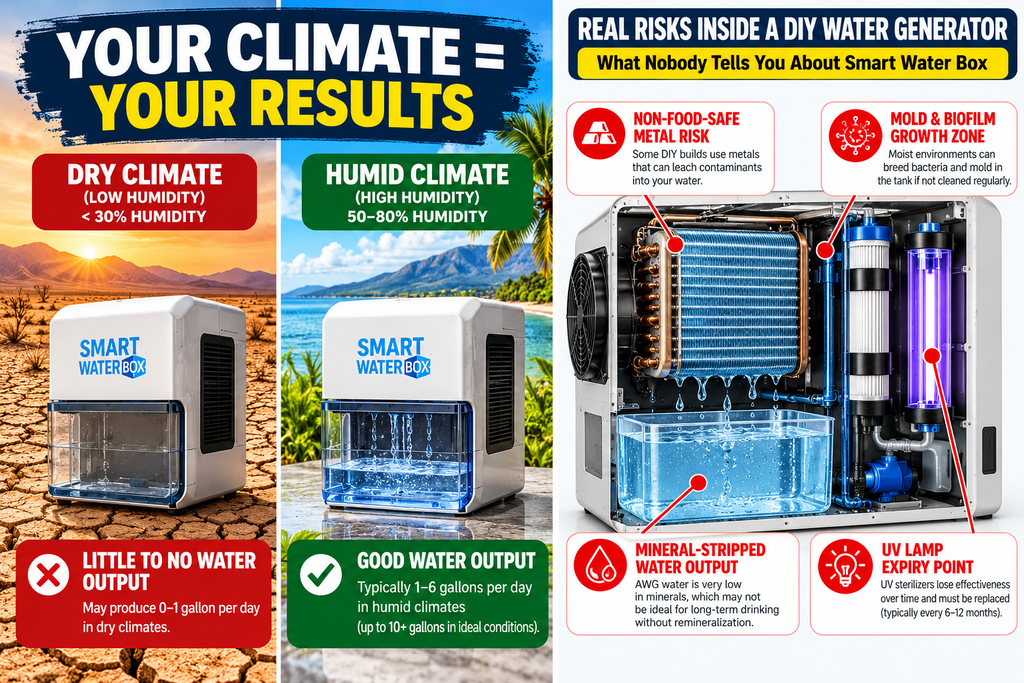
The marketing headline says Smart Water Box can produce up to 40 gallons of clean water per day. Technically, that number is not made up — but it represents a theoretical maximum under near-perfect tropical conditions: 80%+ relative humidity, temperatures around 86°F, and a well-optimized larger build.
What most people actually get:
- 50–65% humidity (Midwest US, moderate climates): 1–4 gallons/day
- 60–75% humidity (coastal areas, Pacific Northwest): 3–6 gallons/day
- Below 45% humidity (Mountain West, inland areas): under 0.5 gallons/day
One Reddit user in Texas with moderate humidity wrote: “The instructions are solid and the science is real. My main complaint is that the ’40 gallons per day’ number is completely unrealistic for a home DIY build. I’m getting maybe 1–2 gallons per day. Still useful — but the marketing should be more honest.”
Independent analysis from EmpSurvive.com confirmed: “At 40–50% humidity, independent testing on comparable DIY AWG builds typically yields 6–12 liters per day, not 40 gallons. The 40-gallon figure assumes near-tropical conditions most buyers will never see.”
The fix: Go in expecting 1–6 gallons per day in moderate humidity. If that’s useful for your situation, great. If you need more than that to justify the build, it may not be worth it.
👉 Try Smart Water Box Risk-Free — 60-Day Money-Back Guarantee
Problem #2 — It Simply Won’t Work in Dry Climates
This isn’t a flaw in the product. It’s physics. And it’s responsible for most of the negative reviews you’ll find.
An atmospheric water generator cannot extract water vapor that isn’t there. Below roughly 40% relative humidity, output becomes negligible. Below 30%, a standard condensation-based AWG produces almost nothing at all — regardless of how well you follow the instructions or how good the parts are.
A user from Colorado posted in a prepper forum: “I live in Colorado. Very dry climate. Got basically nothing from this. Should have done my humidity research first. The guide itself is fine, the technology is real, but it just doesn’t work well in low-humidity environments. Not a scam — just not right for my location.”
Regions where Smart Water Box is likely to disappoint:
- Desert Southwest (Arizona, Nevada, New Mexico) — avg. humidity 10–30%
- Mountain West (Colorado, Utah, Wyoming) — avg. humidity 20–45%
- High-altitude regions globally
- Dry inland areas during winter months anywhere
How to check before you buy: Google your city name + “average humidity by month.” If most months sit below 45%, this product is not a good match for your location. Look at a water filter system instead — one that works with whatever water source you have access to.
Problem #3 — Real Water Safety Risks That Nobody Mentions
This is the risk most review sites completely skip — probably because it requires actual research to understand.
Atmospheric water generation condenses water vapor from the air around you. That sounds clean, but the air itself carries contaminants — especially in urban areas. Research published in a peer-reviewed water quality journal found that AWG-produced water in urban environments can contain elevated levels of particulates and airborne pollutants that collect during the condensation process.
The specific risks:
1. Airborne VOCs and chemicals. In areas near factories, heavy traffic, agricultural spraying, or wildfire smoke, the air contains volatile organic compounds and chemical residues. These can enter the condensation process and end up in collected water. The activated carbon filter stage is meant to address this — but a poorly maintained or wrong-grade carbon filter may not catch everything.
2. Non-food-safe coil materials. This is a serious one. AWG Europe, a professional atmospheric water generation company, published a warning specifically about DIY AWG builds: “Air conditioning materials used in the heat exchanger and evaporator do not meet food safety standards — the resulting gray water can contain heavy metal salts.” If someone builds the Smart Water Box unit using repurposed AC components rather than food-safe specified parts, there is a real contamination risk. The guide addresses this — but how carefully the builder follows material specifications matters enormously.
3. Microbial contamination. The condensation coil and collection system create a damp environment that can support bacterial and algal growth if not maintained. Published engineering research on low-power AWG systems notes specifically that “special techniques must be employed to ensure water and storage systems remain free of pathogens and algae.”
The fix: Follow the guide’s material specifications exactly. Use only food-grade parts. Keep the filtration stack maintained on schedule. Consider getting a basic water quality test kit ($20–$30 at most hardware stores) to verify your output periodically — especially if you’re in an area with air quality concerns.
For a full breakdown on water safety from this type of system, see our article on whether Smart Water Box water is safe to drink — it covers filtration stages and what independent testing shows.
Problem #4 — The Mineral Deficiency Risk (This One Is Backed by Science)
This is perhaps the most underreported risk of any atmospheric water generator system, DIY or commercial.
Water produced by condensation is essentially distilled water — it starts with near-zero mineral content. Research published in the journal Water (MDPI) found that AWG-produced water had very low concentrations of calcium (Ca²⁺) and magnesium (Mg²⁺). The same study noted that calcium and magnesium deficiency in drinking water has been linked to health problems including tooth loss, rickets, and cardiac issues when water is the primary mineral source over extended periods.
Separately, a DIY AWG technical guide noted that pure condensate has an acidic pH of roughly 5.5–6.2 because it absorbs CO₂ from the atmosphere. Drinking acidic, mineral-free water over long periods can theoretically leach minerals from teeth and bone tissue.
This does NOT mean Smart Water Box water is dangerous for occasional use or emergency backup. For supplemental drinking or short-term emergency use, it’s fine. The risk kicks in if this becomes your sole or primary daily drinking water source without addressing the mineral gap.
The fix: Add a remineralization stage to the build. A calcite/coral calcium mineral cartridge restores pH and adds trace Ca²⁺ and Mg²⁺. These are inexpensive ($10–$20) and easy to add to any filtration stack. Alternatively, use mineral drops in your collected water. The EPA recommends calcium at 1–135 mg/L and magnesium at 25–50 mg/L in drinking water. A simple mineral cartridge gets you into that range.
👉 Get Smart Water Box + 3 Free Bonuses — 60-Day Guarantee
Problem #5 — The Real Build Cost Is Higher Than Advertised
The guide is $39.69. But the marketing occasionally implies you can build the whole system for as little as $50 total. That’s not accurate for most people.
Community reviews consistently put the real build cost at $80–$150 in parts, with some users reporting up to $120 just in components depending on local sourcing and whether they added an optional UV stage. Here’s a rough breakdown:
| Component | Estimated Cost |
|---|---|
| Cooling unit / hermetic compressor | $30–$60 |
| Evaporator coil (food-safe) | $15–$35 |
| Fan / intake | $10–$20 |
| 3-stage filter set + UV module | $25–$50 |
| Food-grade collection tank | $15–$25 |
| Mineral cartridge (recommended add-on) | $10–$20 |
| Housing, tubing, misc hardware | $10–$20 |
| Total realistic range (guide + parts) | $155–$270 |
That’s still massively cheaper than a commercial AWG unit ($1,500–$5,000+), but significantly more than “$39” or “$50 to build.” Budget for the higher end to avoid frustration mid-build.
Also worth noting: the ClickBank refund covers the $39.69 guide price only. If you buy parts and decide the system isn’t for you, those costs are not refundable through ClickBank. So confirm your local humidity is viable BEFORE buying parts.
Problem #6 — Mold and Biofilm Risk in the Storage Tank
This is a maintenance problem, not a design flaw — but it’s real and rarely discussed.
Any system that collects and stores water in a tank creates conditions for microbial growth if it’s not properly managed. Published engineering documentation on AWG systems specifically notes that the water storage system must be regularly cleaned and treated to prevent pathogen and algae buildup over time.
For a unit that’s actively used and maintained, this is straightforward to manage. But for a unit that sits idle for a few weeks (say, during a period when you’re not needing the backup supply), stagnant water in the tank can develop biofilm or mold — particularly if the tank isn’t sealed or UV-treated.
The fix:
- Use food-grade, opaque tanks (light encourages algae growth)
- Drain and clean the tank if it will sit unused for more than 7–10 days
- Include a UV purification stage after the tank, not just before it
- Run the unit regularly rather than letting it sit
Problem #7 — Non-Food-Safe Materials Risk
This connects to the water safety section above but deserves its own entry because it’s specific to the DIY nature of the build.
Commercial AWG units use certified food-grade materials throughout every component that contacts water. Your home build uses whatever parts you source. If a builder substitutes a cheaper non-food-safe metal coil or uses a generic plastic container instead of a food-grade tank, the condensed water can pick up heavy metals, plasticizers, or chemical leachates from those materials.
AWG Europe’s technical warning was direct: materials used in standard air conditioning equipment do not meet food safety standards — and resulting water from AC-based DIY builds can contain toxic heavy metal salts.
This is avoidable — the Smart Water Box guide specifies food-safe materials. The problem arises when builders try to cut costs by substituting parts. Do not substitute coil or tank materials to save money. The food-safe specification is not optional.
Problem #8 — Some Local Regulations May Apply
This one surprises people. The Smart Water Box disclaimer itself notes: “Some home alteration alternatives may be illegal in your town, city, state, province or country. It is your responsibility to inquire with your local authority.”
In practice, most private homeowners building a small-scale water collection device for personal use face no legal issues. But there are edge cases worth being aware of:
- HOA restrictions: Some homeowner associations prohibit exterior DIY modifications. If your build requires any outdoor components, check your HOA rules first.
- Rental properties: If you’re renting, landlord permission may be needed for any electrical or structural modifications.
- Commercial or shared buildings: Installing a water collection system in a commercial, multi-unit, or shared-utility building may require permits.
- Selling generated water: If you ever intend to sell or supply water produced by a DIY AWG to others, food safety regulations kick in. For personal use only, this is generally not an issue.
For the vast majority of homeowners building a personal backup water system, none of these apply. But it’s worth spending five minutes verifying before you start the build.
Problem #9 — Email-Only Support with Slow Response Times
This is a minor complaint relative to the others, but worth naming.
Customer support for Smart Water Box runs through email at the website contact page (watersmartbox.com). There is no live chat, no phone number, and no instant support option. Response times run 1–3 business days.
Community feedback suggests that when responses do come, they’re thorough and actually resolve issues. But if you hit a snag mid-build on a weekend and want quick help, you’re likely looking at the buyer community and the video instructions rather than vendor support.
For ClickBank order issues — billing, refunds, duplicate charges — contact ClickBank directly at clkbank.com. They handle those separately from the vendor and are typically faster.
👉 Try Smart Water Box Risk-Free — Full 60-Day Refund Available
Risk Summary Table — All Smart Water Box Problems at a Glance
| Problem | Severity | Avoidable? | Fix |
|---|---|---|---|
| Misleading “40 gal/day” claim | Medium — expectation gap | Yes | Research realistic output for your climate first |
| Doesn’t work in dry climates | High — if in dry region | Yes (don’t buy) | Check humidity before purchase |
| Air contaminants in urban areas | Medium | Mostly | Use proper carbon + UV filtration; test output water |
| Mineral deficiency in output water | Medium — for long-term daily use | Yes | Add remineralization cartridge or mineral drops |
| Higher actual build cost | Low-Medium | Yes | Budget $150–$200 total, not $39 |
| Mold/biofilm in storage tank | Medium | Yes | Regular cleaning, opaque tank, UV post-storage |
| Non-food-safe materials (if substituted) | High — if materials aren’t correct | Yes | Follow guide spec; never substitute coil or tank materials |
| Local HOA / rental rules | Low — minor edge case | Yes | Check your tenancy/HOA rules before building |
| Slow email support | Low | Partially | Use buyer community forums; contact ClickBank for order issues |
Despite the Problems — Is Smart Water Box Still Worth Buying?
For the right person: yes. The problems above are real, but nearly all of them are avoidable with preparation.
The technology works. The blueprint is legitimate. The 60-day ClickBank guarantee means your financial risk is essentially limited to the $39.69 guide price (your parts spend is separate). And the water independence value — having a functional backup water source that doesn’t rely on pipes or municipal systems — is genuine.
The honest assessment from Backyard Freedom Lab put it well: “Buy it as a $39 education in water-from-air with a modest backup payoff — never as a solution to a real water problem.”
The key is knowing exactly what you’re getting and mitigating the risks before you build, not after.
Who Should Definitely NOT Buy Smart Water Box
Be honest with yourself on these before you commit:
- You live in a dry climate. Below 45% average humidity, the output is too low to justify the build. This is the biggest filter. Check your humidity first.
- You want a plug-and-play device. This is a DIY guide. You will buy parts and build something. If that’s not appealing, this isn’t for you.
- You need to replace your entire water supply immediately. Even in perfect conditions, a basic home build supplements your water — it doesn’t fully replace a family’s daily water needs from day one.
- You’re not willing to do any maintenance. A poorly maintained unit creates the contamination and mold risks listed above. This takes some ongoing attention.
- You have severely polluted local air (industrial area, near heavy agricultural spraying). The filtration is good but not rated for heavily contaminated air streams.
- You’re renting and can’t make modifications. Get your landlord’s permission first, or skip it.
How to Avoid Every Problem Listed Above — A Pre-Build Checklist
If you decide to buy, do these things before you start:
1. Check your local humidity. Search “[your city] average humidity by month.” If consistently above 50%, you’re in good territory. Below 45%, don’t buy parts yet.
2. Set your output expectations at 1–6 gallons/day for a standard build in moderate humidity. Plan accordingly.
3. Budget $150–$200 total, not $39. Source parts before you start to avoid mid-build surprises.
4. Use ONLY the materials specified in the guide. No substitutions on the coil or tank. Food-grade only.
5. Add a remineralization cartridge. It’s $10–$20 and solves the mineral gap entirely. Don’t skip this if the water will be consumed daily.
6. Test your output water. A basic TDS/pH meter is around $15 at most hardware stores. Run a check within the first week of operation.
7. Clean the tank regularly. Every 1–2 weeks if in regular use. Drain it completely if it will sit unused for more than 7–10 days.
8. Check your HOA or tenancy agreement if you’re not in a standalone owned home.
👉 Get Smart Water Box — Try It Risk-Free for 60 Days
FAQ — Smart Water Box Problems and Risks
Is Smart Water Box a scam?
No. The guide is legitimate and the technology works. The complaints that exist are mostly about overstated marketing claims and geographic mismatch, not fraud. No verified reports of payment theft or fake products have been found across Reddit, prepper forums, or the BBB.
What’s the biggest risk with Smart Water Box?
Buying it if you live in a dry climate. Output below 45% humidity is negligible, and nothing about the build process changes that. Climate is the single biggest risk factor.
Is the water produced safe to drink?
Yes, when the system is built with food-safe materials and the filtration is maintained correctly. The main safety risks are using non-food-safe parts (avoidable), air quality contaminants (filtered but should be monitored), and low mineral content (solved with a remineralization cartridge). See our dedicated article on Smart Water Box water safety for a deeper breakdown.
Can I get a refund if it doesn’t work for me?
Yes — ClickBank’s 60-day money-back guarantee covers the $39.69 guide purchase. It does not cover parts you’ve already bought. Request refunds through ClickBank at clkbank.com. This works even if you bought through an affiliate link.
What if I’m in a dry climate — is there anything I can do?
For truly dry climates (below 30% humidity), standard condensation AWGs are impractical. Some DIY builders in drier areas have experimented with desiccant-based AWG designs, which absorb moisture rather than condensing it and can work at lower humidity levels. However, that’s a more complex build not covered by the Smart Water Box guide. For dry climates, a good water filter system or rainwater collection setup is generally more practical.
Does the mineral issue mean I shouldn’t drink the water?
No — for occasional use or emergency backup, it’s fine. The concern is for people making this their primary daily drinking water source without adding minerals back. Add a remineralization cartridge and the issue is solved.
How long does the build take?
Most first-time builders complete a working unit in 4–8 hours across a weekend, once parts are sourced. The main time variable is parts sourcing.
Are there upsells?
Yes — a standard ClickBank upsell sequence appears after the main purchase. The core guide is complete on its own and you don’t need the upsell to build a working system.
Can I get help if I get stuck mid-build?
Email support is at the contact page on watersmartbox.com. Response typically takes 1–3 business days. For faster help, the buyer community forums are useful for common build questions. Most issues that come up are common and documented in the video walkthrough.
Final Verdict — Problems Acknowledged, But Not Dealbreakers for the Right Buyer
Smart Water Box has real problems. The output claims are overstated. The water carries specific risks if materials or maintenance aren’t right. Dry-climate buyers get almost nothing. And the total spend is more than the headline price suggests.
But here’s the thing: all of those problems are either avoidable or manageable with a bit of preparation. The climate issue is a binary filter — check your humidity, and you know immediately if this is for you. The materials and maintenance issues are addressed in the guide itself. The mineral gap costs $15 to fix.
What Smart Water Box is not: a miracle device, a complete off-grid water solution for everyone, or a replacement for understanding your local climate before you buy.
What it is: a legitimate, affordable entry point to water independence for people in humid regions who are willing to build it correctly and maintain it properly. With a 60-day ClickBank refund covering the guide price, the financial risk of trying it is genuinely low.
Go in with clear eyes, check your humidity first, budget accurately, and follow the material specs — and it’s a solid buy for the right situation.
👉 Try Smart Water Box — 60-Day Risk-Free Guarantee
Further Reading:
- Smart Water Box Full Review 2026 — The complete review covering everything from what you get to who it’s for and our final verdict.
- How Smart Water Box Works — A detailed step-by-step breakdown of the condensation and filtration process.
- Is Smart Water Box Water Safe to Drink? — Covers filtration stages, mineral content, and what to watch for in output water quality.
Disclaimer: This article is for informational purposes only. Results from Smart Water Box vary based on local climate conditions, build quality, and maintenance practices. The water safety information references published research; individual results depend on your specific build. Some links are affiliate links — we may earn a commission at no extra cost to you. Always verify local regulations before building any DIY water system. Updated September 2026.